
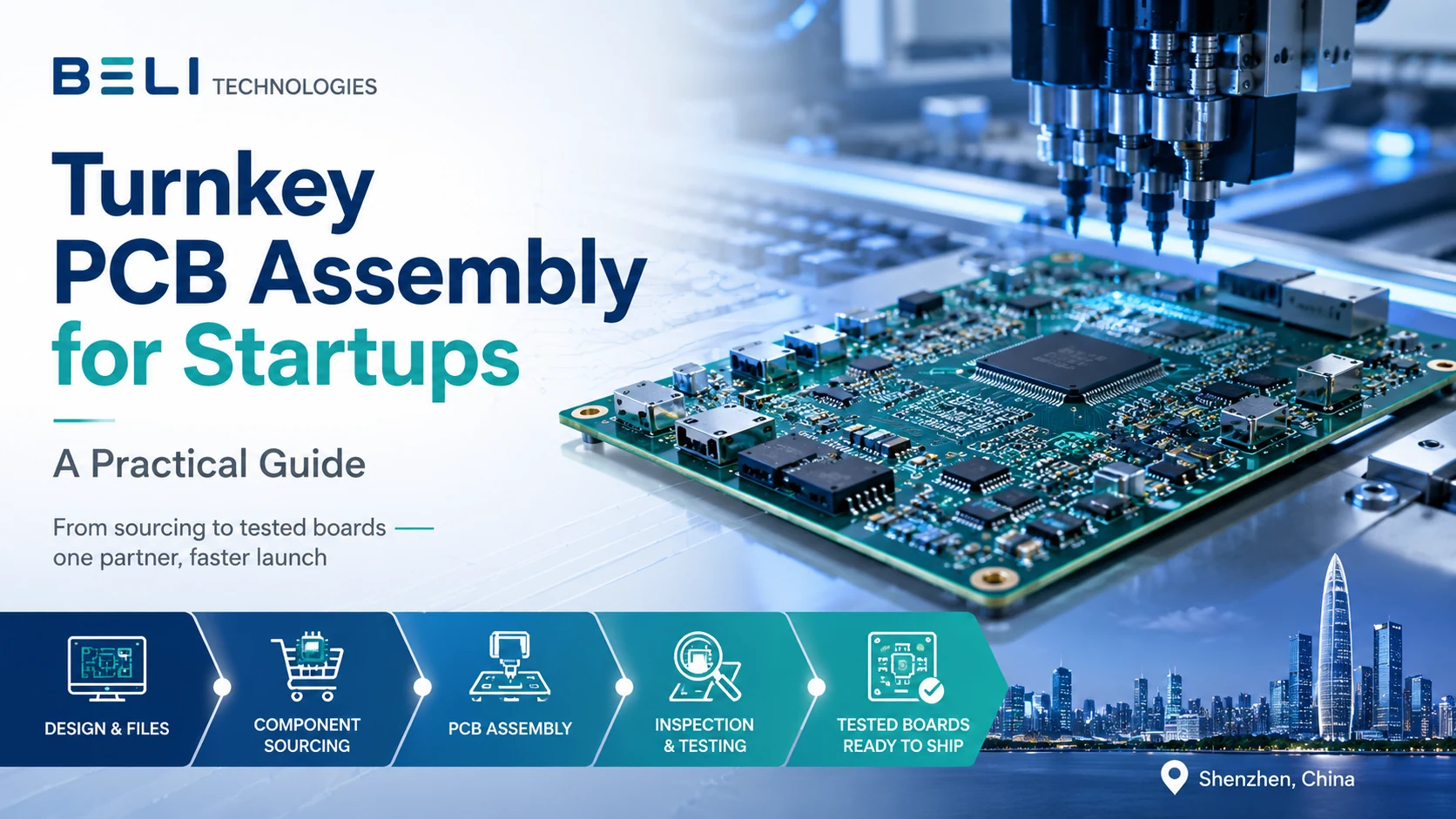
Short answer: Turnkey PCB assembly means one manufacturer takes your Gerber, BOM and pick-and-place files and returns finished, tested boards — sourcing every component, fabricating the PCB, running SMT and through-hole assembly, and inspecting the result. For a startup with no purchasing function, it removes coordination work that nobody on a five-person team has time to do.
Most hardware startups do not fail because the firmware was wrong. They lose weeks because a reel of one MCU sat in customs, a fab house and an assembly house disagreed about who owned a footprint error, or nobody noticed a part had gone end-of-life until the boards were already panelised. Turnkey exists to collapse those hand-offs into a single accountable supplier. This guide covers what turnkey actually includes, exactly who owns which deliverable, how the model maps onto EVT, DVT and PVT builds, and the three assumptions that most often cost early-stage teams a month.
What does turnkey PCB assembly actually cover?
In a turnkey engagement, the manufacturer owns the entire path from design files to a tested assembly. That means procuring the bare board, buying every line on the BOM, printing and placing, reflowing, soldering through-hole parts, inspecting, testing, and shipping. You supply data and decisions; the factory supplies materials, process and labour.
The important word is accountable. If a joint fails on a turnkey board, there is no argument about whether the pad was wrong, the part was counterfeit or the profile was off — one supplier owns all three variables. That single-throat-to-choke property is worth more to a small team than any line-item saving, because debugging a cross-supplier defect burns engineering time you cannot buy back.
BELI Technologies runs turnkey PCB assembly alongside fabrication, sourcing, wire harness and test, so the whole chain sits under one roof rather than being brokered out.
Turnkey deliverables checklist: who is responsible for what
The single most useful thing you can do before a first build is agree, in writing, who owns each item below. Ambiguity here is where schedules die.
| Deliverable | You supply | The EMS supplies | Who decides |
|---|---|---|---|
| Board data | Gerber or ODB++ at a released revision, plus stackup and impedance targets | DFM review before anything is built; fabrication to your stackup | You (design intent) |
| Bill of materials | Manufacturer part numbers, quantities, designators, approved alternates | Availability, lifecycle and alternate analysis; procurement | You approve every substitution |
| Placement data | Pick-and-place / centroid file with rotations and side | Stencil design, machine programming, solder paste inspection (SPI) | EMS (process) |
| Components | Nothing — that is the point of turnkey | Parts from authorized distributors and original manufacturers, with full traceability, original packaging, and 100% visual plus X-ray sampling on incoming | EMS, inside your approved BOM |
| Assembly | Assembly notes, IPC class, special handling (moisture-sensitive parts, press-fit, hand-load items) | Solder paste printing and SPI, SMT placement, nitrogen reflow, wave or selective soldering for through-hole | EMS (process) |
| Inspection | Acceptance criteria and any cosmetic requirements | AOI and X-ray on every order, plus ICT or functional test | Shared — you set the bar, the EMS measures against it |
| Functional test | Test specification, firmware image, a golden unit if you have one | Custom fixture build, ICT or functional execution, test reports with the shipment | You define pass/fail |
| Beyond the board | Enclosure drawings, wire lists, packaging artwork | Wire harness to IPC/WHMA-A-620 Class 2/3, conformal coating, potting, box build as options | You |
| Compliance | Product certification strategy and lab bookings | Build records, material declarations, component traceability under ISO 9001:2015 / ISO 13485:2016, RoHS- and REACH-compliant processes | You — certification belongs to the brand, not the factory |
| Logistics | Incoterm, destination, importer of record, HS classification | Worldwide dispatch from Shenzhen by DHL, FedEx or UPS, or air and sea freight for larger volumes | You |
Two rows deserve emphasis. First, alternates: turnkey does not mean the factory silently swaps parts. A responsible EMS proposes an alternate and waits for your written approval, because a 10% tolerance change on a feedback divider is your problem, not theirs. Second, compliance: no manufacturer can CE-mark or FCC-certify your product. They supply the evidence trail; you own the declaration.
Turnkey or consignment — where does the split actually change?
Consignment means you buy the parts and ship them in; the factory only assembles. The practical difference is narrower than it sounds: it comes down to who carries procurement risk, who eats the cost of a shortage, and who is accountable when a reel arrives short or a part turns out to be counterfeit. Under turnkey the factory carries all three. Under consignment you do, along with kitting accuracy and attrition allowances. Both are legitimate, and BELI supports turnkey and consignment with no fixed ratio, so a hybrid — you supply the two long-lead parts you already stock, the factory buys the other 180 lines — is entirely normal. The cost and risk mechanics of each model are worked through in our breakdown of what drives PCBA cost in China.
Misjudgement 1: "Turnkey must be more expensive"
This is the most common and the most expensive assumption. It compares the wrong two numbers: the factory's turnkey material line against the price you would pay on a distributor website, ignoring everything else the buy actually costs you.
The lines startups routinely forget when they self-source: minimum packaging quantities and reel breaks on parts you only need 40 of; multiple inbound freight charges from several distributors; import duty and brokerage on parts entering China; attrition stock so the line does not stop at the 47th board; the cost of holding leftover inventory for a design that will change; and the engineering hours your own team spends chasing purchase orders instead of debugging firmware. On low volumes the last item usually dominates everything else.
Turnkey also changes the shape of the risk. If a part is quoted, ordered and then arrives wrong, that is a supplier problem to solve rather than a founder problem. Genuine material savings come later, from consolidation, approved alternates and packaging choices — not from paying distributor spot prices on 40-piece buys.
Misjudgement 2: "We should wait until the design is frozen"
Teams often delay contacting a manufacturer until layout is final, on the theory that there is nothing to discuss before then. The opposite is true: the cheapest input a factory gives you arrives before the design is frozen.
Send a draft BOM while you are still choosing parts and a competent sourcing team will flag the lines that are single-source, on allocation, or already heading for end-of-life — while changing them is a symbol edit rather than a respin. Send preliminary Gerbers and DFM feedback catches annular-ring, clearance and footprint problems at the point where fixing them is free.
What that is worth is easiest to see in a case where it did not happen. A US smart-sensor client only discovered a problem after boards had been built and shipped: their team could not insert components without excessive force. A DFM review of the incoming Gerbers found drill holes specified at 0.8 mm with no allowance for lead insertion tolerance, and the 1.2 mm hole correction plus a pin-header swap was turned around in 48 hours with zero rework. Run before the first build, that review is free; run after, it is paid for on the assembly floor.
DFM review is included with every BELI order, prototype or production, so there is no commercial reason to hold files back until the last minute. If you are unsure what is worth sending at an early stage, our guide to the files required for a PCBA quotation lists what each file must contain and what is optional.
Misjudgement 3: "Nobody will take a 10-board order"
Plenty of volume-oriented factories will indeed decline, because changeovers cost them line time. But prototype-friendly EMS providers structure around exactly this. BELI has no MOQ for prototypes — a single board is a valid order — and quick-turn prototype assembly takes 48 hours once boards and components are in hand. A full turnkey order in which we also source the parts typically runs 2 to 3 weeks end to end, with the component lead time, not the assembly, being the variable.
What matters more than the minimum is whether the same supplier can still build you at volume. Lines that run 0201/01005 chips and 0.4 mm-pitch BGAs at ±0.03 mm placement, on boards from 45 × 45 mm to 680 × 500 mm, with roughly 52 million placements a month of capacity, do not need to change when your order goes from 10 to 10,000. The small-batch economics are covered in more depth in our low-MOQ and small-batch PCB assembly guide.
From first board to mass production: what turnkey looks like at each stage
Turnkey is not one service; what you are actually buying changes as the product matures. The stage names below follow the standard EVT/DVT/PVT gates, explained in full in our guide to EVT, DVT and PVT hardware build stages.
| Stage | Typical quantity | What you are really buying | How turnkey applies | What sets the schedule |
|---|---|---|---|---|
| Bring-up board | 1–5 | Proof the layout is buildable at all | Full turnkey; no MOQ, so one board is a real order | Bare-board fabrication — as fast as 24 h for 1–2 layers, 3–7 working days multilayer |
| EVT | 20–50 | Proof the design works | Turnkey plus DFM feedback; 48-hour quick-turn assembly once boards and parts are ready | Component lead time (standard parts 3–7 days) and your own bench-test loop |
| DVT | 50–200 | Proof the product meets its full specification | Turnkey plus test investment: custom fixtures built in 2–3 working days, ICT to ≥95% node coverage | Fixture build, environmental and certification testing |
| PVT | 200–1,000 | Proof the factory can build it repeatably | Turnkey on the production lines, with the full AOI, X-ray and ICT or functional test flow and test reports shipped with the boards | Yield analysis and corrective action, not the build itself |
| Mass production | Full volume | Units, on schedule, at a stable cost | Turnkey, or a shift to consignment on selected lines once you hold stock | Component procurement and forecast accuracy |
Quantity ranges here are the common industry pattern rather than a rule — a simple sensor node may need 15 EVT boards, a complex consumer device several hundred PVT units. The structural point is that the model does not have to change between rows. If your first bring-up board and your first production run happen on the same lines, with the same stencils, fixtures and inspection criteria, nothing has to be requalified at the point where you can least afford a delay.
What "tested board" should mean before you accept it
Turnkey ends at a tested assembly, so define what tested means. At minimum, expect automated optical inspection on every board and X-ray on hidden joints — the connections under a BGA or QFN are invisible to optical inspection, so without X-ray those joints ship unverified. Beyond that, expect either in-circuit test or functional test against your specification.
Every BELI order runs through AOI, X-ray, and ICT or functional test, at a first-pass yield of ≥99.5%. Where a dedicated fixture is not yet economical — typically at bring-up and EVT — flying-probe testing covers prototypes and small batches instead. For products that need reliability evidence before certification, our functional testing service also covers burn-in up to 24 hours and environmental stress screening from −40 to +85 °C at 20–98% RH. Ask for the test report to ship with the boards, not on request.
What to send for a turnkey quote
Three files unlock a real number: Gerber or ODB++, a BOM with manufacturer part numbers and approved alternates, and a pick-and-place file with rotations. Add assembly notes, target quantity, target IPC class, and your delivery destination and the quote comes back without a round of clarification emails.
What slows quotes down is predictable: BOMs listing "100 nF capacitor" with no MPN, alternates written as "or equivalent" with no tolerance or voltage constraint, missing rotations in the centroid file, and quantities described as "a few hundred, maybe". Each of those turns a 24-hour turnaround into a two-day conversation. BELI returns quotes within 24 hours when the file package is complete, and signs an NDA before you share anything.
How to sanity-check a turnkey supplier before you commit
Ask five questions and the answers will separate a real manufacturer from a broker: Do you fabricate, source, assemble and test in-house, or subcontract? Where do components come from, and can you show traceability and original packaging? What inspection runs on every order, and what first-pass yield do you actually hold? Is there an MOQ, and does the prototype line become the production line? Will you sign an NDA and give me a named engineer? A supplier who answers all five concretely — with numbers, not adjectives — is one you can scale with. BELI publishes its PCB and SMT manufacturing capability specifications in full, and every project is handled by a dedicated English-speaking project engineer from quotation through delivery.
Start a turnkey build
If you are a small hardware team weighing up whether to hand off sourcing and assembly, the cheapest next step is not a decision — it is a file review. Send your Gerber, BOM and pick-and-place files for a turnkey PCBA quote and you will get a DFM review, a BOM checked for availability, lifecycle and alternates, and an itemised quotation back within 24 hours. There is no MOQ for prototypes, so the first build can be a single board, and the same lines carry you through to volume without a supplier change.
Related reading: Prototype PCBA in China: A Practical Guide · EVT, DVT, PVT: Hardware Build Stages and Your EMS · Key Questions to Ask Before Outsourcing PCBA