
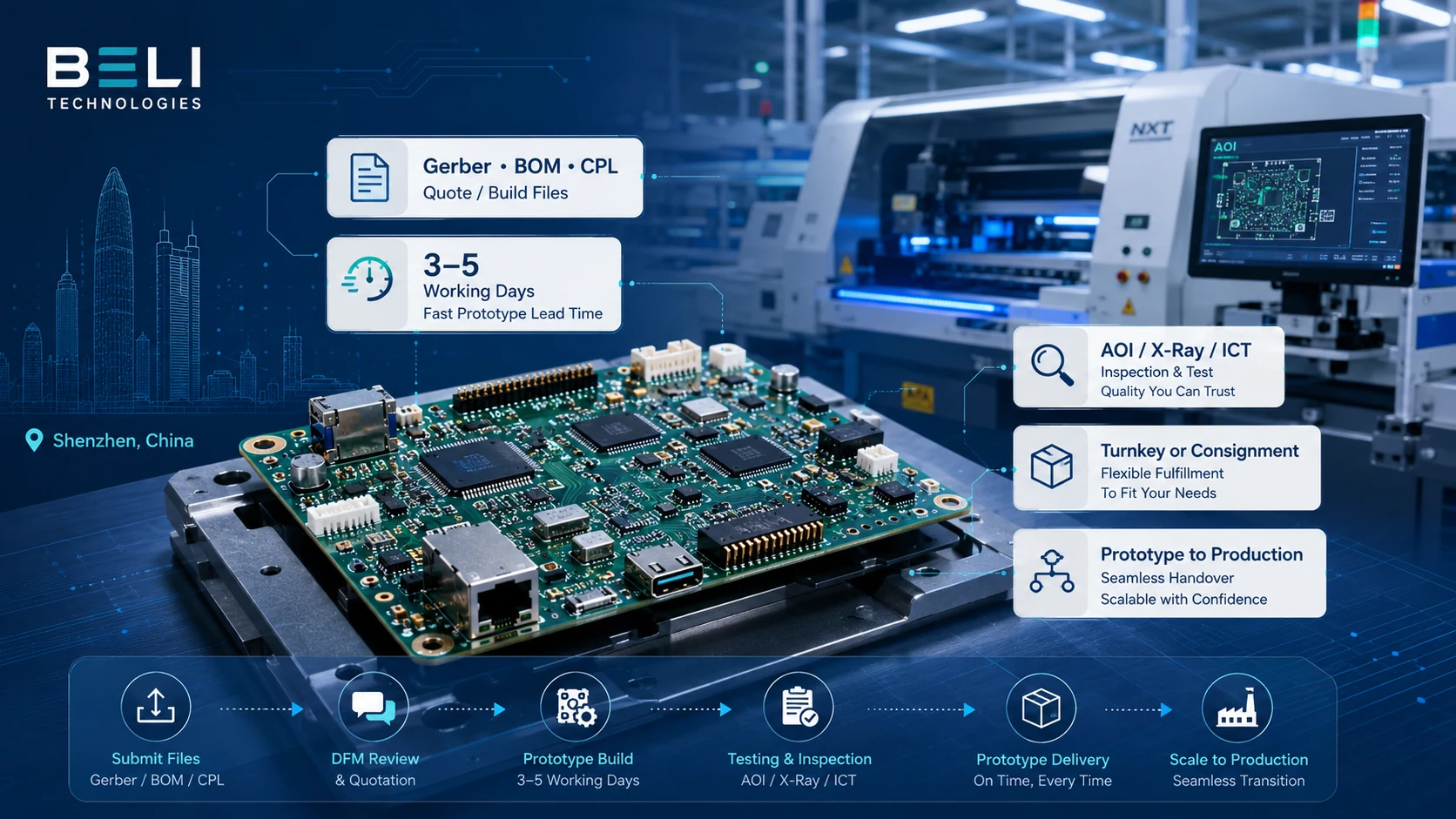
Short answer: A prototype PCBA run in China needs three files — Gerber or ODB++, a BOM with manufacturer part numbers, and a pick-and-place file — plus decisions on stackup, surface finish and who buys the parts. Turnkey prototypes typically take two to three weeks; only 48 hours of that is assembly.
Prototyping in Shenzhen is fast when the data package is complete and slow when it is not. The delays that hurt a first build are almost never machine time — they are a missing drill file, an ambiguous part number, or a question that sat unanswered overnight because nobody on your side had authority to answer it. This guide covers what a prototype PCBA supplier actually needs, where the calendar days genuinely go, why first articles get rejected, and what to test at this stage instead of over-testing a design that is still moving.
What do you need to prepare before ordering a prototype PCBA?
Split your preparation into three categories: files (machine-readable data), decisions (choices only you can make), and information (context the factory cannot infer). Missing files stop the quote. Missing decisions stop the build after the quote — which is worse, because you have already burned a week feeling productive.
| What | Type | What happens if it is missing |
|---|---|---|
| Gerber (RS-274X) or ODB++, including drill data | File | No fabrication quote at all. A missing or mismatched drill file is one of the most common reasons a same-day quote turns into a multi-day exchange. |
| BOM with manufacturer part numbers | File | Descriptions like "10k resistor" cannot be purchased. Every ambiguous line becomes a clarification email, and each email round-trip costs a day across time zones. |
| Pick-and-place / centroid (CPL) with rotations | File | Placement programming stalls. Wrong or absent rotation data on polarized parts is a classic source of a reversed diode on the first article. |
| Assembly drawing or notes (top/bottom views, do-not-populate list) | File | DNP parts get fitted, or fitted parts get skipped. Technically optional; in practice it prevents the most embarrassing rework. |
| Layer count, board thickness, copper weight, stackup | Decision | The factory picks a default stackup. It will be manufacturable, but it may not match the impedance your RF or high-speed nets assumed. |
| Surface finish (ENIG, HASL, lead-free HASL, immersion silver or tin) | Decision | Default finish may not suit fine-pitch parts or your reflow profile. Changing finish after the panel is imaged means a new bare board. |
| Impedance requirement, if any, with target values and tolerance | Decision | Controlled impedance is a build instruction, not something the fab infers from your trace widths. Unstated means uncontrolled. |
| Turnkey or consignment, and your alternates policy | Decision | Purchasing cannot start. Worse, an unstated alternates policy means either an unnecessary delay waiting for an exact part, or a substitution you never approved. |
| Quantity and whether spare bare boards are wanted | Decision | Ordering exactly the number of boards you need leaves nothing for destructive analysis or a rework attempt when one unit dies on the bench. |
| Test level required (visual/AOI only, flying probe, or functional) | Decision | You get standard inspection, which may be exactly right — but if you expected a functional pass/fail report, that has to be defined before the build, not after. |
| Moisture-sensitive, temperature-limited or fragile parts flagged | Information | Standard reflow gets applied to a part that should have been baked or hand-soldered. Failures show up weeks later as intermittent faults. |
| Destination country, shipping method, and who is importer of record | Information | Finished boards sit on a shelf waiting for paperwork. Customs, not manufacturing, becomes the bottleneck on your first build. |
If you want the file-level detail — what a usable BOM column set looks like, which Gerber layers to export — our guide to the files required for a PCBA quotation goes line by line.
What does a prototype PCBA lead time actually consist of?
"Two weeks" is not one process; it is four, and only one of them is assembly. Understanding the split tells you where to push and where pushing achieves nothing. For turnkey PCB assembly at BELI Technologies, quick-turn prototype assembly takes 48 hours once boards and components are on hand, and turnkey orders including component sourcing typically run two to three weeks end to end. Here is where those weeks go.
| Stage | Typical duration | What drives it | Can it be compressed? |
|---|---|---|---|
| Quote & DFM review | Quotes returned within 24 hours; DFM review included with every order | Completeness of your files; number of open questions | Yes — entirely under your control. Send everything at once. |
| Bare board fabrication | As fast as 24 hours for 1–2 layer; 3–7 working days for multilayer | Layer count, HDI features, impedance control, exotic materials | Somewhat — but a 12-layer HDI board will not be built at 2-layer speed. |
| Component sourcing | 3–7 days for standard parts; longer for allocated or hard-to-find items | The single longest-lead line on your BOM, not the average | Only by designing around availability, approving alternates, or consigning parts you already hold. |
| SMT assembly (quick-turn prototype) | 48 hours once boards and parts are ready | Stencil, programming, double-sided reflow, through-hole and hand-work content | Rarely the bottleneck. Compressing here saves hours, not days. |
| Inspection & test | Runs with assembly; a custom test fixture adds 2–3 working days | AOI and X-ray are standard; flying probe suits prototypes; ICT needs a fixture | Yes — skip fixture-based ICT at prototype and use flying probe instead. |
| Shipping | 3–7 days by express to North America, Europe and Israel | Destination, customs clearance, declared value and paperwork | Partly — have the commercial invoice details agreed before boards finish, not after. |
Read that table once and the strategy is obvious: the schedule is set by your BOM and your response speed, not by the SMT line. A team that answers a DFM question in two hours and pre-approves alternates will beat a team with an identical design by a week.
Why do first articles get sent back? The five recurring causes
Prototype rejections tend to cluster into a short list, and almost all of them are data problems rather than workmanship problems. Each one is worth checking against your own package before you release it.
- Footprint and land pattern errors. A part that does not match its pad geometry cannot be rescued on the line. This is what a proper design-for-manufacturability review is for, and it is why we run DFM on every order rather than as a paid extra.
- Hole and clearance geometry that only fails at the next assembly step. The board passes electrical test, then will not accept a connector or a standoff. We documented exactly this in a Gerber hole issue we fixed for a US sensor client, where holes specified at 0.8 mm were opened to 1.2 mm and the corrected boards shipped in 48 hours with zero rework.
- Polarity and orientation. Silkscreen says one thing, the centroid file says another. When the two disagree, the machine follows the file.
- Unapproved substitutions. A part was out of stock, someone fitted an equivalent, and nobody told the designer it had a different tolerance or thermal rating. Fix this by writing your alternates policy into the order rather than leaving it to goodwill.
- Mismatched expectations on test and cosmetics. A prototype built to functional-sample expectations arrives with minor cosmetic marks; the customer expected production finish. Define the acceptance criteria in advance and this disappears.
Notice that four of the five are settled before any machine starts. The prototype stage rewards paperwork discipline more than it rewards factory selection.
What should you test at the prototype stage — and what should you not?
Over-testing a moving design wastes money; under-testing it wastes a build cycle. The rule of thumb: at prototype, test what tells you whether the design is right. Defer anything that tests whether the process is repeatable, because there is no stable process yet.
| Check | At prototype? | Reasoning |
|---|---|---|
| AOI and X-ray on BGA/QFN joints | Yes | Hidden joints are unverifiable by eye. Debugging a firmware problem that is actually an open BGA ball costs days. |
| Flying-probe electrical test | Yes | Fixture-free, so it suits a design that is still changing. It separates "my design is wrong" from "this board is faulty". |
| Power-up and functional bring-up | Yes | The whole point of the build. Even a simple rails-and-current check catches gross errors before you spend a week on firmware. |
| Custom ICT fixture with high node coverage | Usually not yet | A fixture is built for one board revision. Build it when the layout is frozen — ours take 2–3 working days, so it is not a schedule risk later. |
| Burn-in and temperature/humidity screening | Selectively | Worth doing early only where thermal or environmental margin is a known design risk. Otherwise it belongs to the design-validation stage. |
| Yield statistics and process capability | No | Ten boards produce no meaningful yield data. This question belongs to a pilot run, not a prototype. |
| Formal EMC and safety certification | No — pre-scan only | Certification samples must represent the final design. Informal pre-compliance scans on prototypes are cheap insurance; formal testing this early is money burned twice. |
If you want the full staging logic, the EVT, DVT and PVT build stages lay out which validation belongs to which gate. And when the design does freeze, functional testing and ICT pick up where flying probe leaves off, with node coverage of 95% or better on a purpose-built fixture.
Why prototype and production unit prices cannot be compared directly
Nearly every hardware team does this once: receives a prototype quote, divides by the quantity, multiplies by the production forecast, and panics. The arithmetic is meaningless, because a prototype price is dominated by costs that do not scale with quantity.
Setup work — stencil, machine programming, feeder loading, first-article check, engineering time — is charged once whether you build 5 boards or 5,000. Bare-board fabrication at prototype quantities cannot fill a production panel, so you pay for panel area you do not use. Components bought in reel-break quantities cost far more per piece than components bought on full reels, and some suppliers will not break a reel at all. None of these disappear at volume; they are simply divided across far more units.
The practical consequence: use prototype quotes to compare suppliers on responsiveness and engineering quality, and ask separately for an indicative volume structure to compare on unit economics. The mechanics of the split are set out in prototype versus mass production cost, and the wider cost drivers in what PCBA actually costs in China. What you should never do is choose a long-term manufacturing partner because their prototype was slightly cheaper — the sample is not the product, and the quote is not the price.
Turnkey or consignment for a first prototype run?
Consignment — you buy and ship the parts — makes sense when you already hold inventory, when a part is on allocation and you have a distributor relationship the factory does not, or when a specific lot must be used. It also puts every purchasing error on your side of the line.
Turnkey means the factory quotes the BOM, buys the parts, and owns the shortage risk. For a first build this usually wins, because one missing low-value passive holds the whole kit hostage just as effectively as a missing microcontroller. We handle electronic component sourcing through authorized distributors and original manufacturers with full traceability and original packaging preserved, with 100% visual inspection plus X-ray sampling on incoming parts — which matters more at prototype than people assume, because a counterfeit or out-of-spec part in a ten-board build is indistinguishable from a design fault until you have wasted a week chasing it. Both models are supported with no fixed ratio, so a hybrid — you consign the two parts you already have, we buy the rest — is entirely normal.
How do you work across the time-zone gap without losing a day per question?
Shenzhen runs at UTC+8. That is roughly 15–16 hours ahead of US Pacific, 12–13 ahead of US Eastern, 6–7 ahead of Central Europe, and 5–6 ahead of Israel, depending on daylight saving. The consequence is not that communication is hard; it is that each unanswered question costs a full calendar day, and the cost is invisible until you add it up at the end of the project.
Three habits remove most of that loss. First, batch: when a DFM report arrives, resolve every point in one reply rather than sending three separate answers over three days. Second, pre-authorize: decide in advance who may approve an alternate part or a minor geometry change, and say so in writing, so the factory does not stop and wait for a decision that was never contentious. Third, give conditional answers — "if the 0.8 mm hole is a problem, open it to 1.2 mm and proceed" is worth a day compared with "please advise". Europe and Israel additionally have a genuine overlap window with the Chinese afternoon; teams in those regions should schedule the one weekly call inside it rather than at their own convenience. US teams do not have overlap, so the discipline matters more: an answer written before you finish your working day is waiting when the factory opens.
How many prototype boards should you build?
More than you think, but not many more. Building only the units you plan to bring up leaves no margin for a board destroyed during debug, none for destructive cross-sectioning if a joint looks suspicious, and none to ship to a colleague in another location. Because there is no MOQ for prototypes, the marginal cost of a few extra assembled boards is small next to the setup cost you have already paid — and small next to the two weeks it takes to get more. Ordering a handful of extra bare boards is cheaper still, and gives you spares for a partial rebuild if a component substitution needs evaluating.
Does the prototype supplier need to be the production supplier?
Not strictly — but changing suppliers between prototype and volume means repeating work you have already paid for: a new DFM cycle, new stencils and programs, new fixtures, and a new learning curve on your board's quirks. It also removes the one thing that makes a prototype genuinely predictive, which is that the same processes and inspection criteria will be used at volume.
The practical test when choosing a prototype partner is whether they can still build your board at 100 times the quantity. Ask about board-size limits, the smallest components and BGA pitches the lines handle, layer count, and whether inspection at volume includes AOI, X-ray and ICT as standard. Our full process window is on the manufacturing capability page, and boards up to 42 layers from PCB fabrication run into the same assembly lines that hold first-pass yield at 99.5% or better in production.
A realistic first-build sequence
Put together, a well-run first prototype looks like this: send a complete package and get a quote within a day, with DFM review included; resolve every DFM point in one exchange; approve the BOM including any alternates; bare boards fabricate while parts are purchased; assembly runs in 48 hours once both are in-house; AOI and X-ray inspection before packing, plus flying-probe test if you asked for it at quotation; express shipment lands in 3–7 days. Two to three weeks, most of it purchasing, almost none of it machine time — and the parts you control are the parts that move the date.
If you have a board ready to build, send us your Gerber, BOM and pick-and-place files and you will get a quote within 24 hours, with DFM review included on every order — plus a straight view of which BOM lines are going to set your schedule. There is no minimum order for prototypes, and the same lines that build your first ten boards will build your first ten thousand.
Related reading: Low-MOQ and Small-Batch PCB Assembly · PCB Prototype vs Mass Production Cost · What Files Are Required for a PCBA Quotation