
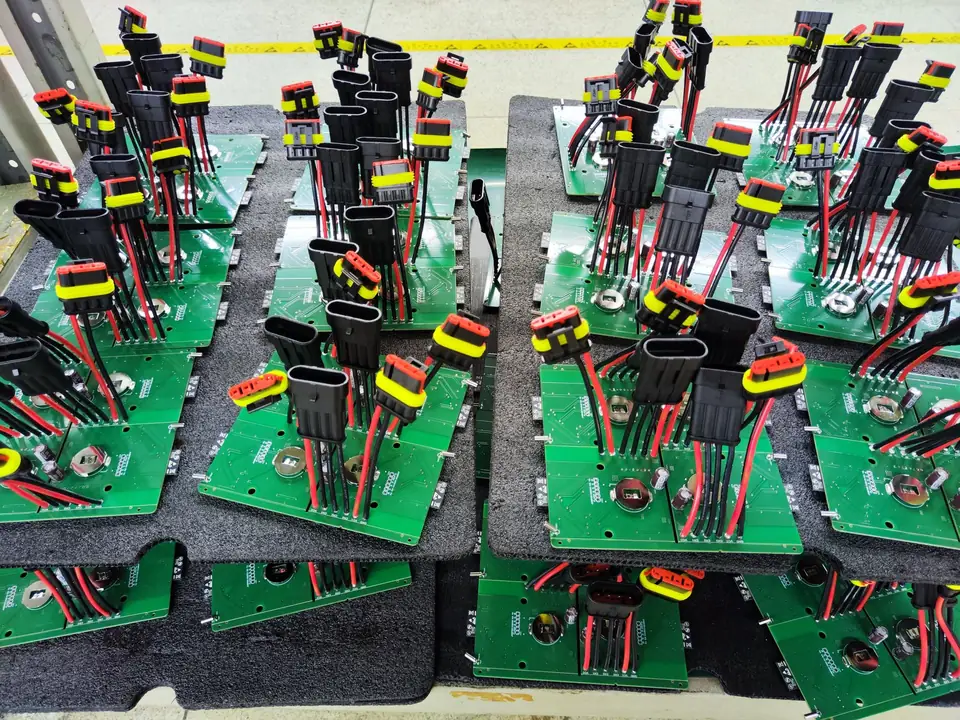
Short answer: Box build assembly is everything that happens after the PCBA is finished — fitting boards into an enclosure, running harnesses, mounting panels and labels, testing the assembled unit, and packing it to ship. It succeeds or fails on mechanical documentation, not on soldering skill.
Buyers who have run several PCBA orders often assume box build is the same relationship with a bigger deliverable. It is not. A PCBA order is defined almost entirely by three files that the industry has standardised — Gerber, BOM, pick-and-place — and a factory can quote from them without a phone call. A box build order is defined by mechanical drawings, a wire list, a label spec, a test spec and a packing spec, and none of those have a universal format. That difference is why box build quotes come back slowly, why they come back with assumptions attached, and why two quotes for the same product can differ by a factor that has nothing to do with labour rates. This article maps the boundary between the two, then works through what you actually have to hand over to get a box build priced properly.
What does box build assembly actually include?
Box build — also called system integration, final assembly, or simply "the box" — is the step that turns tested circuit boards into a shippable product. There is no single industry definition of its scope, which is exactly the problem, but a typical box build covers some or all of the following:
- Enclosure assembly: fitting boards, standoffs, gaskets, thermal pads, fans, displays and mechanical hardware into a plastic or sheet-metal housing, to a torque and sequence defined by your drawings.
- Harness and internal cabling: building and routing the wire harnesses that connect boards to each other, to connectors on the panel, and to power inputs, plus strain relief and cable management.
- Panel work and labelling: front and rear panel fitment, membrane keypads, light pipes, product labels, rating plates, serial numbers, regulatory marks and barcodes.
- Software or firmware loading: flashing the product image before or after enclosure closure, then verifying the version that shipped.
- Final functional test: testing the assembled product against its specification rather than testing the board against a netlist.
- Packing: foam or moulded pulp inserts, accessories, documentation, retail or bulk cartons, pallet configuration and shipping marks.
BELI Technologies lists complete box-build assembly as a value-added option alongside conformal coating and potting on its turnkey PCB assembly line. Which of the six activities above are in scope for a specific programme is a conversation, not a default — and having that conversation before the quote is the single highest-leverage thing a buyer can do.
Where does PCBA stop and box build begin?
The boundary matters commercially because it decides who owns a failure. If a unit fails final test, the question "was that a board defect or an assembly defect?" only has a clean answer when both sides agreed in advance where one process ended and the other started. The table below is the boundary as most EMS providers draw it.
| Process step | Which side it belongs to | What you have to supply for it |
|---|---|---|
| Solder paste, SMT placement, reflow | PCBA | Gerber or ODB++, BOM with manufacturer part numbers, pick-and-place file |
| Through-hole and odd-form parts | PCBA | Assembly drawing showing orientation, height limits and any hand-fitted parts |
| AOI, X-ray, ICT or flying probe | PCBA | Netlist and test points for ICT; nothing extra for AOI and X-ray |
| Conformal coating or potting | PCBA value-add | Keep-out drawing showing masked connectors, and the material you require |
| Depanelisation and board-level cleaning | PCBA | Panel drawing and any handling constraints for edge-mounted parts |
| Wire harness fabrication | Harness — a separate build feeding box build | Wire list, gauge and colour per circuit, connector part numbers, lengths, workmanship class |
| Enclosure fabrication or tooling | Usually outside both — a mechanical supplier | 3D models, 2D drawings with tolerances, material, finish and colour specification |
| Fitting boards into the enclosure | Box build | Exploded assembly drawing, fastener list, torque values, build sequence |
| Internal cable routing and strain relief | Box build | Routing diagram or annotated photographs of an approved sample |
| Firmware or software loading | Box build — confirm scope explicitly | Image file, programming procedure, version control rule, licence position on your IP |
| Labels, serial numbers, regulatory marks | Box build | Artwork files, material and adhesive spec, placement drawing, serial number scheme |
| Product-level functional test | Box build | Written test specification with pass and fail limits, plus any test equipment or golden unit |
| Packing and cartonisation | Box build | Packing spec, carton and insert drawings, accessory list, drop or transit requirement |
Two rows deserve a flag. Enclosure fabrication is the one most buyers assume is included and most often is not — an EMS may coordinate a mechanical supplier, but machining, moulding and tooling are a distinct sourcing exercise with its own lead time and its own tooling cost. And firmware loading sits on the boundary deliberately: whether it happens at all, and whether it happens before or after the box closes, is a per-programme decision you must confirm with your manufacturer rather than assume. If the difference between a bare board and a populated assembly is still fuzzy, our explainer on PCB versus PCBA sets out the earlier boundary in the same terms.
Why is box build more document-dependent than PCBA?
A PCBA is described by a data set that machines consume directly. The pick-and-place file tells a placement head where to go; the Gerber tells a stencil cutter where to open apertures. Ambiguity is limited because the file formats themselves force precision, and a DFM review — included with every BELI order — catches most of what remains.
Box build is human work described by drawings. An operator has to interpret "route the display cable behind the standoff, not over it", and there is no file format that enforces that instruction. The consequences are asymmetric in a way that surprises people: a board assembly defect is usually caught by AOI or ICT within minutes of being created, while a box build defect — a cable pinched under a lid, a gasket seated one turn too tight, a label 3 mm off centre — is often only caught at final test or, worse, by your customer. That is why box build is priced on documented labour minutes and why a factory that cannot see your documentation cannot honestly quote it.
The practical implication is that the time you spend producing a clear assembly drawing and a clear test spec is not overhead. It is the mechanism by which you convert your engineer's tacit knowledge into something a line of operators can repeat ten thousand times. Programmes that skip that step do not save the time; they spend it later on rework, on debugging failures over video calls, and on arguing about whose defect it was.
What do you need to provide before a box build quote?
Below is the package a manufacturer needs before it can quote a box build without wrapping the number in assumptions. The right-hand column is the useful one: it tells you what actually goes wrong when a given item is missing, which is usually more persuasive to a busy engineering team than "please send everything".
| Document | What the factory does with it | What happens if it is missing |
|---|---|---|
| 3D models plus dimensioned 2D drawings of the enclosure and mechanical parts | Checks fit against the PCBA outline, plans the build sequence, estimates labour minutes | The quote is a guess. Interference between a tall capacitor and a rib is discovered on the line, not on screen |
| Exploded assembly drawing with build order and fastener list | Writes work instructions, sets torque values, defines the order of operations | Every operator invents their own sequence, so unit-to-unit variation appears and cannot be traced |
| Mechanical BOM, separate from the electrical BOM | Sources screws, standoffs, gaskets, thermal interface material, cable ties, feet | Small parts are quoted as an allowance, then re-priced later — the classic source of quote drift |
| Wire list and harness drawing per assembly | Builds harnesses to length, selects crimp tooling, defines the continuity test | Harnesses come out the wrong length or with the wrong pinout, and the whole box build waits on a rebuild |
| Cable routing diagram or an approved golden sample | Fixes routing, bend radius, strain relief and clearance from hot or moving parts | Pinched or chafed cables that pass final test and fail in the field months later |
| Label artwork with material, adhesive and placement spec | Orders label stock, sets placement fixtures, positions regulatory marks | Labels peel, curl on curved surfaces, or sit where a certification body will not accept them |
| Serial number and traceability scheme | Generates and records serials, links each unit to its build and test data | A field failure cannot be mapped back to a batch, so a containment action becomes a full recall |
| Firmware image plus written programming procedure | Where programming is agreed as in scope, loads and verifies the image and records the version against the serial | Units ship with mixed or stale firmware versions and nobody can prove which unit has what |
| Product-level test specification with pass and fail limits | Builds or programs the final test station and defines what "good" means | The factory tests what it can infer, which is rarely what you meant, and disputes follow the first failure |
| Cosmetic acceptance criteria | Sets limits on scratches, gaps, gloss and colour match | Cosmetic rejections at your incoming inspection that the factory had no way to anticipate |
| Packing specification, carton drawings and accessory list | Sources inserts and cartons, sets pack-out labour, calculates pallet and freight volume | Freight cost is estimated badly and units arrive damaged in transit |
| Target volume, build phase and forecast | Decides whether to build with fixtures or by hand, and how much tooling is justified | A pilot run gets priced with volume tooling, or a volume run gets priced with pilot labour |
If you have already assembled the file package for board-level work, this list is the mechanical counterpart to it — our guide to the files required for a PCBA quotation covers the electrical half in the same detail.
How does the wire harness fit into a box build?
Harnesses are where box build most often stalls, because they are the one sub-assembly that is genuinely custom to your mechanical design and cannot be bought from a catalogue. Length depends on routing, routing depends on the enclosure, and the enclosure is frequently still changing when the first harness is ordered.
Sourcing harnesses from the same partner that does the box build removes a hand-off at exactly the point where the hand-off hurts. BELI builds custom wire harnesses and cable assemblies to IPC/WHMA-A-620 Class 2 and Class 3 workmanship standards, in wire gauges from AWG 28 to AWG 10, using JST, Molex, TE and other connector systems, with 100% continuity testing on every assembly. There is no minimum order quantity, samples turn around in 1 to 2 days, and batch production typically runs about two weeks — which means a harness revision driven by a mechanical change does not have to be a three-week schedule event.
Two specification points are worth settling early. First, name the workmanship class explicitly: Class 2 and Class 3 differ in crimp inspection rigour and defect tolerance, and quoting the wrong one either overpays or under-specifies. Second, put the wire colour and gauge for every circuit in the wire list rather than only on the schematic — operators build from the wire list, and a mismatch between the two documents is one of the most common causes of a mis-wired first article.
Who owns the enclosure, and how does that change the quote?
There are three workable arrangements, and the difference between them is worth more money than any labour-rate negotiation.
You supply the enclosure. You buy housings from your own mechanical supplier and consign them to the assembly factory. This gives you complete control over tooling ownership and cosmetic quality, and it puts the entire inbound logistics burden on you. It works well when you already have a tooling relationship, and the consignment mechanics are the same ones described in our comparison of turnkey versus consignment assembly: agree receiving checks, attrition allowance and excess disposition before anything ships.
The factory coordinates a mechanical supplier. You keep the design and the factory manages the buy — an arrangement to ask about rather than assume, since enclosure sourcing sits outside standard PCBA and box-build scope. It reduces your coordination load but requires you to be explicit about who approves first articles and who owns the tool.
Off-the-shelf housings. For instrumentation, industrial control and many low-volume products, a standard extruded or die-cast housing with custom panel machining avoids tooling cost entirely. It is almost always the right answer below a few thousand units a year, and it is the arrangement most often overlooked by teams who default to custom moulding because that is what consumer products do.
Whichever route you take, settle tooling ownership in writing. A tool paid for by you and held by a supplier is a commercial hostage; a tool paid for by the supplier and amortised into unit price is a different deal with different exit costs. Neither is wrong, but the two are frequently confused.
What testing happens at box-build level versus board level?
Board-level and product-level tests answer different questions and neither substitutes for the other. Board test asks whether the assembly matches the design: at BELI that means AOI and X-ray on every order, with in-circuit test reaching at least 95% node coverage, or flying probe where a dedicated fixture is not economical for the quantity. Custom test fixtures are built in 2 to 3 working days, and first-pass yield on the SMT lines runs at or above 99.5%.
Product-level test asks whether the finished unit does what the specification says. It exercises the interfaces a user touches — buttons, displays, connectors on the panel, power input — and it catches the failure classes that only exist once the box is closed: a connector seated but not latched, a fan blocked by a cable, a display ribbon that works on the bench and fails when the lid is torqued down. BELI's functional testing service also covers burn-in for up to 24 hours and environmental stress screening from -40 to +85 degrees C at 20 to 98% RH, with test reports delivered alongside every shipment.
What you have to supply is the definition of pass. Write the test specification as a list of measurable checks with numeric limits, in the order they should be performed, with a stated action for each failure mode — retest, rework, or scrap. A test spec written as prose descriptions of desired behaviour cannot be turned into a test station. Mechanical qualification such as drop, vibration and transit testing sits with an accredited test laboratory rather than with the assembly factory, and it is a separate scope item you appoint and budget for yourself.
Firmware loading, labels and packaging: what to confirm with your EMS
These three items are in scope for some box build programmes and out of scope for others, and each one has a specific question you should ask before assuming.
Firmware. Ask whether programming happens at the factory at all, at what point in the build, how the loaded version is recorded against each serial number, and what happens when you issue an update mid-run. Ask also how the image is protected — whether your binary is held in escrow, how many copies exist, and whether programming is done through a fixture that limits read-back. If your product carries intellectual property in software, this deserves a clause, not an email.
Labels and regulatory marks. Ask who supplies the artwork, who owns placement accuracy, and how a change to your regulatory marks propagates to the line. Certification marks are placed at your instruction and on your legal authority — the factory prints what you specify, and no manufacturer can certify your product for you. Our guide to CE, FCC and UL compliance for China-built PCBA sets out that split in full.
Packaging. Ask whether the factory expects you to supply a finished packing design or whether it can propose one, whether inserts are sourced locally, and how transit protection will be validated. Packaging design and drop testing are specialist disciplines; treat them as a scope item to be agreed rather than something that arrives free with the assembly quote.
How do box build lead times and volumes actually work?
Box build lead time is rarely set by the assembly itself. It is set by whichever input arrives last, and for most programmes that is either the enclosure or a long-lead component. Working backwards from the ship date, the chain typically runs: component procurement, then bare board fabrication, then PCBA, then harness build, then box build and final test, then packing.
The board-level portions of that chain are fast and well characterised. BELI returns board-level quotes within 24 hours, sources standard components from authorized distributors and original manufacturers in 3 to 7 days, runs quick-turn prototype assembly in 48 hours once boards and parts are on site, and completes turnkey orders including sourcing in typically 2 to 3 weeks. Harness samples take 1 to 2 days with batches around two weeks. Enclosures, by contrast, can take anywhere from days for machined prototypes to many weeks for a new injection mould — which is why the mechanical path, not the electronic one, usually determines your launch date.
On volume, the useful principle is that box build labour does not benefit from automation the way SMT does. A 52-million-placement-per-month SMT capacity means board cost falls sharply with quantity; a hand-assembled enclosure costs roughly the same per unit at 100 as at 1,000 until fixtures and jigs are justified. That is not a reason to avoid low-volume box build — it is a reason to expect the cost curve to look different from the one you know from PCBA, and to ask specifically at what quantity fixtures become worthwhile for your product.
How should box build fit into EVT, DVT and PVT?
Box build is where hardware programmes most often discover that their stage gates were optimistic. The pattern to avoid is validating electronics and mechanics on separate schedules and integrating them for the first time at the pilot build.
A more reliable sequence puts a small number of fully integrated units into the DVT build, however rough the enclosure is, because that is the earliest point at which cable routing, thermal behaviour inside a closed box, connector accessibility and assembly ergonomics can be observed at all. By PVT the build sequence, work instructions, fixtures and final test flow should be the ones that will be used in mass production, and the number worth demanding from the factory is not just yield but assembly time per unit — that figure is what your unit cost rests on, and it only becomes real when operators build to written instructions rather than to an engineer's supervision. Our breakdown of EVT, DVT and PVT hardware build stages covers the gate criteria in detail.
One more scheduling point: build the first article review into the plan explicitly. A first article on a box build should be inspected against the drawing dimension by dimension, photographed from every side, and signed off in writing before the balance of the run starts. Skipping it to save three days regularly costs three weeks.
How does shipping change for a finished product?
Finished goods are bulkier and more fragile than boards, and the freight arithmetic changes accordingly. Bare PCBAs ship in trays and travel well by express courier; boxed products are volumetric, which means air freight is priced on dimensional weight and sea freight becomes attractive far earlier than it does for boards.
BELI ships worldwide from Shenzhen via express couriers including DHL, FedEx and UPS, or by air and sea freight for larger volumes, with express delivery to North America, Europe and Israel typically taking 3 to 7 days depending on destination and customs. Beyond that, plan your own import arrangements with your freight forwarder and customs broker — duty classification, import documentation and delivery terms for a finished consumer or industrial product are a different exercise from importing components, and they belong to your side of the transaction.
Getting a box build quote that holds
The fastest route to a box build number you can budget against is to send the mechanical package at the same time as the electrical one, rather than after the PCBA quote is settled. BELI Technologies quotes and manages PCB fabrication, component sourcing, SMT and through-hole assembly, wire harness build, functional testing and box-build assembly as one program from Shenzhen. The boards we ship are built at partner manufacturing facilities certified to ISO 9001:2015, ISO 14001 and ISO 13485:2016; certificate copies (registrar, certified site, validity dates) are provided on request with any RFQ. Full process specifications are on the manufacturing capability page. Send drawings, BOMs, the wire list and whatever test and packing specification exists — even in draft — and ask us to quote the whole product rather than just the boards. Where something is missing, we will tell you what it is and why it changes the number, which is more useful than a quote that quietly assumes.
Related reading: What Files Are Required for PCBA Quotation · EVT, DVT, PVT: Hardware Build Stages and Your EMS · Key Questions to Ask Before Outsourcing PCBA